

A search for septic pumping in Burlington starts in a city where almost every occupied property uses municipal wastewater. Drive outward into Chittenden County and the picture changes quickly. The village may have sewer while the next rural road relies on individual tanks. A house may use gravity distribution, or it may depend on a pump and floats to send measured doses into a raised mound. Four local facts explain the difference.
1. Burlington is the landmark, not the typical septic lot
Burlington’s long-term control plan estimated 16,197 occupied housing units and about 82 households using septic systems from 2014–2018 data. The estimate is old enough that it should not be used as a current address list, but the proportion makes the broader point: a tank is unusual inside the city. The first responsible step is to check the utility bill, property records, approved wastewater plan, and visible components.
That prevents an awkward kind of false diagnosis. A slow drain in a sewered Burlington house may be a building drain or municipal-side question, not a tank ready for pumping. Burlington Water Resources, reached at 802-863-4501, is the official contact for City wastewater accounts. A private pumping contractor cannot change a utility record.
Around the city, whole-town labels remain unreliable. Hinesburg and Richmond have village utilities. Milton has a municipal service core. Colchester’s lakeshore sewer project is converting defined segments in phases. Charlotte, Jericho, Underhill, and Westford lean much more heavily on private treatment, but shared systems and future projects can still create exceptions. The property address beats the town stereotype every time.
2. Vermont soil and bedrock make the mound a normal design tool
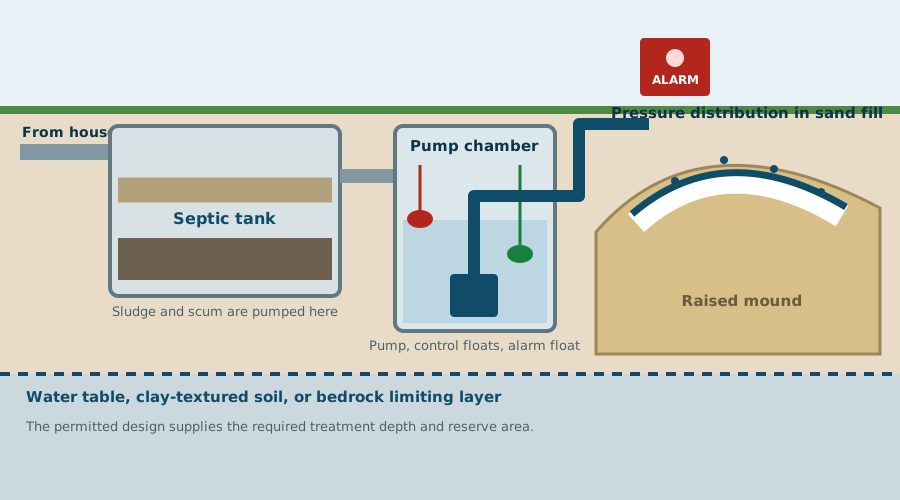
A conventional field needs enough suitable, unsaturated soil below its distribution surface to treat wastewater before it reaches a limiting layer. Where the seasonal water table, dense clay-textured soil, or bedrock sits too high, a designer can create the needed treatment depth with specified sand fill. That raised treatment area is the mound visible in many Vermont yards.
Current state rules set standard mound separation at 36 inches over an induced water table or clay-textured soil and 48 inches over bedrock. Those numbers come from the 2023 Wastewater System and Potable Water Supply Rules. They are design conditions evaluated by a qualified designer, not a promise that every hill in a lawn meets the standard.
Raising the dispersal area often removes the possibility of gravity flow. A second chamber receives clarified liquid from the septic tank. Floats control a pump that delivers measured doses through a pressure network. Another float triggers a high-water alarm. This is why “pump the septic” can mean two different tasks: remove solids from the primary tank, or diagnose the equipment that moves liquid to the mound.
Pumping the tank protects the downstream network from sludge and scum. It does not prove the dosing pump, floats, alarm, laterals, or soil are healthy. Likewise, replacing an alarm buzzer does not solve the high liquid level that activated it. A useful service call names the component and tests the cause before recommending the remedy.
3. Winter is an access problem before it is a tank problem
Burlington’s normal annual snowfall is about about 80 inches. Snow does not make settled solids disappear, and a buried tank can still need service in January. It does change how safely a vacuum truck and hose can reach the access. A plow bank may bury the only known marker. An icy grade may be passable for a car but not suitable for a loaded truck. A lawn that looks firm under snow may not support the vehicle.
Owners can reduce the uncertainty without opening the system. Mark each lid before snow, keep the driveway plowed and sanded, tell the dispatcher how far the access sits from firm parking, and identify overhead branches or wires. Do not remove a heavy lid alone or leave an opening unattended. Septic tanks contain dangerous gases and create a fall hazard.
Frozen ground also makes exploratory digging slower. A riser at or near grade can make recurring service safer and more predictable, but riser work should preserve a secure, watertight lid. Surface runoff entering through a loose cover adds hydraulic load exactly when the treatment field has the least room to absorb it.
4. Spring melt can imitate or expose a failing component
Snowmelt and rain raise soil moisture and, in some settings, shallow groundwater. A field that accepts effluent easily during dry weather may slow when the surrounding soil is saturated. Low or damaged access points can admit clear water. Runoff concentrated over a mound can reduce its working capacity. The symptom may be slow fixtures, a high-water alarm, unusually wet ground, or liquid standing high in a tank.
Those observations do not all lead to the same repair. Liquid returning through a damaged tank seam is different from effluent unable to leave through a blocked filter. A failed pump differs from a pump working against a saturated treatment area. Pumping provides immediate storage and lets the operator see accessible parts, but rapid refill without household use is evidence that the source must be found.
During a backup, reduce water use and keep people and pets away from sewage. Do not direct a sump pump into the septic system, drive over a wet field, or add chemical products sold as a way to revive saturated soil. Preserve the evidence: note when the alarm began, recent water use, weather, pump noises, and where wet ground first appeared.
Maintenance under Vermont’s rule is condition-based
Vermont does not assign a universal pump-out interval to every household. Section 1-908 of the current rules requires a tank to be pumped so accumulated sludge and scum do not leave it, and requires the effluent filter to be cleaned so solids do not clog it. That language focuses on what the tank contains and what the system needs.
Tank capacity, residents, water use, food-waste grinding, unusual loads, multiple compartments, and prior measurements all affect the schedule. Ask the operator to record observed solids, note the filter and baffles, and identify which compartments were opened. That record is more useful than copying a generic calendar interval from a different home.
The load also enters a regulated transport chain. A commercial septage transporter must hold a Vermont Waste Transportation Permit under 10 V.S.A. § 6607a. Lawful management may be through an authorized wastewater receiving facility or an ANR-certified residuals program. A contractor should be able to identify the route used; Vermont does not support the simple claim that all land application is banned.
The useful version of “local”
Local septic knowledge around Burlington means checking the utility boundary, recognizing a mound’s working parts, planning for snow access, diagnosing spring water, and following Vermont’s actual permit and transport structure. It does not mean pretending every city home owns a tank. Begin with the address, then name the component and symptom.