
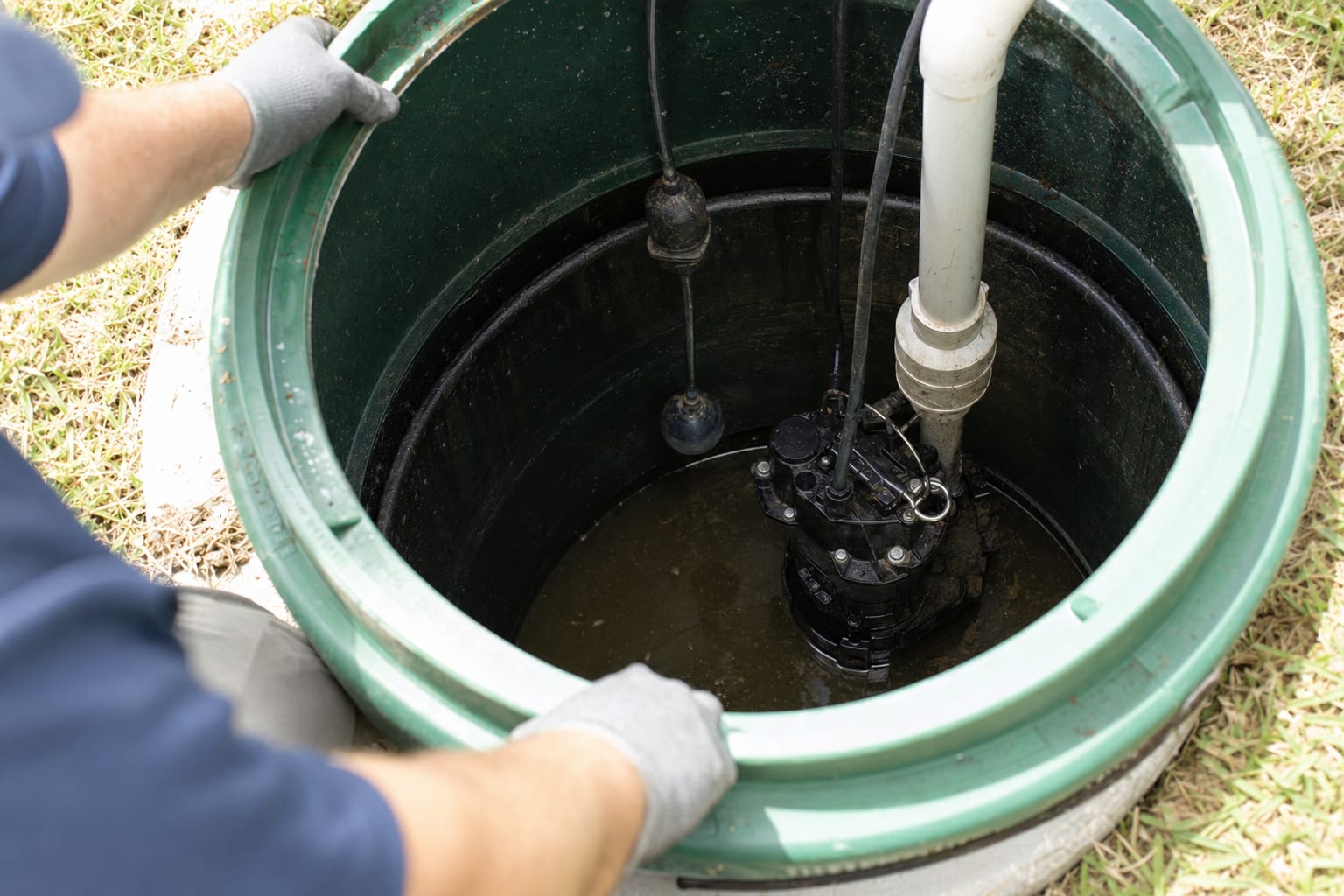
Homes with mounds, uphill fields, or lower-level plumbing may rely on a pump to move wastewater where gravity cannot. The basin can hold clarified septic effluent or raw sewage depending on its place in the system. That distinction controls pump type, solids handling, alarms, and safe service. Begin with the permit plan and the exact basin that is high.
The alarm is an early warning
A high-water float is set above the normal pump control range. When it activates, reduce household flow and note whether the pump runs, hums, trips a breaker, or stays silent. Do not bypass the float or lower the alarm setting. The warning preserves storage time for diagnosis before wastewater reaches a fixture or the ground.
Test power, controls, and mechanics in order
A technician checks the circuit, disconnect, control panel, float positions, connections, pump resistance, and discharge. A tangled float can imitate pump failure. A failed check valve can return each dose to the chamber. A blocked or frozen force main can leave a healthy pump pushing against excess head. Replacing the pump before those checks can leave the same alarm in place.
Mound dosing requires measured delivery
The pressure network is designed to spread a dose across the mound. Pump output, timer or demand controls, and orifice condition affect distribution. A larger pump is not automatically an upgrade because excess flow changes pressure and dose volume. Replacement equipment should match the permitted design or a designer-approved revision, with the alarm and emergency storage left functional.
Winter failures are not all frozen pipes
Cold weather raises freeze risk where shallow piping lacks insulation or steady flow, but power loss, a weak capacitor, ice around an exposed control, or a mechanical blockage can appear at the same time. Snow also hides lids and control boxes. Mark components in fall, maintain safe access, and diagnose before applying heat or digging along an uncertain force-main route.
When pumping helps and when it does not
Pumping the chamber creates storage and makes equipment accessible. It does not repair a failed motor, rewire a control, thaw a line, or restore a clogged pressure network. If the settling tank is due, coordinate both compartments without transferring raw solids into the dosing side. A recent pump-out followed by another alarm calls for testing rather than automatic pumping.
Know when to call another trade
Use a qualified electrician for supply and code issues, a pump technician for controls and mechanical diagnosis, a pumper for accumulated waste and access, and a Vermont designer when equipment changes affect the permitted design. Call emergency services for an energized wet area or confined-space incident. No homeowner should enter a wastewater basin.